
Case studies / Pulse-sequence design
Case study D · Quantum control · simulation
Pulse sequences for interacting spins
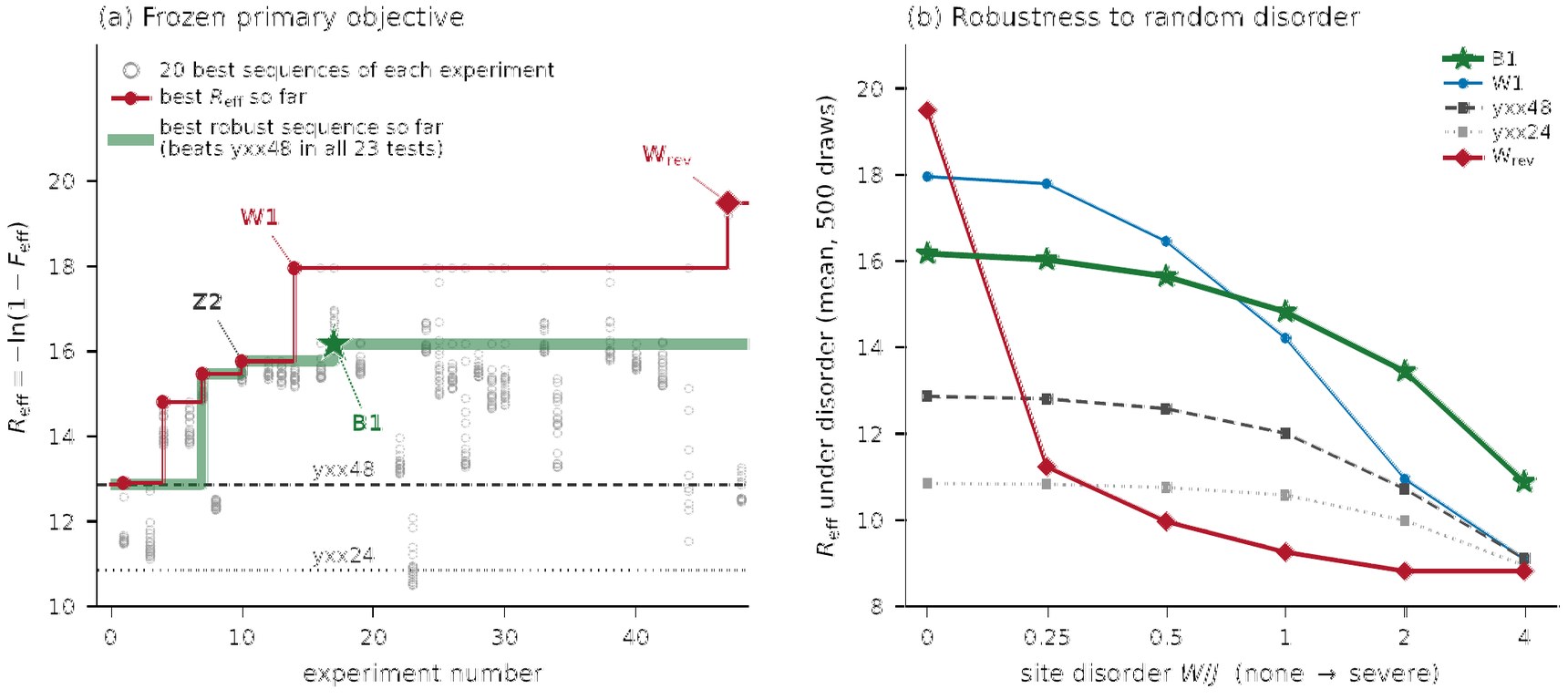
In simulation, a candidate pulse sequence beats a published one >10× and stays ahead under disorder.

The problem
Disorder and spin–spin interactions limit the coherence of solid-state sensing spins. Pulse sequences can average both away, but no general analytic method builds them; the published yxx48 came from deep reinforcement learning.
What we did
Researchers froze the score on the benchmark's simulated 3-spin chain; promoted candidates also faced 23 robustness tests. The collaborative agent ran 49 experiments; at a plateau, one researcher instruction to consult the literature gave the largest gain.
Result
The campaign's B1 has 27× lower infidelity than yxx48 (15× at disorder twice the spin coupling) and wins all 23 robustness tests. The top scorer, from a separate reasoning model, falls below yxx48 at modest disorder.
Keep in mind
Simulation only, in the benchmark paper's spin-chain model; an experimental test is being planned. Disorder was outside the frozen score and was tested afterwards.
In the preprint
Sec. IV.D, “Pulse sequence design,” and Fig. 5 of arXiv:2610.17193 describe the campaign and its checks in more detail.
- Data
- Simulation (dipolar spin-chain model; deterministic frozen evaluator)
- Models (as stated in the preprint)
- Claude Fable 5 + ChatGPT 5.6 Sol at Pro effort (additional analytic reasoning)
- PhysKit version (as stated in the preprint)
- 0.6.0, an earlier version
- Where
- Sec. IV.D, Fig. 5
We list the versions the preprint reports so readers can trace each result to its tools, not as a recommendation: for new work, use the latest release.