
Case studies / Microwave device design
Case study C · Device design · simulation
Microwave waveguide for a quantum sensor
A fabrication-ready microwave waveguide for spin sensors in a 2D material, designed in simulation.

The problem
Near zero field, boron-vacancy spins in hBN have two overlapping resonances, so linearly polarized drive gives no first-order signal. Circular polarization restores it but needs two perpendicular in-plane fields 90° out of phase.
What we did
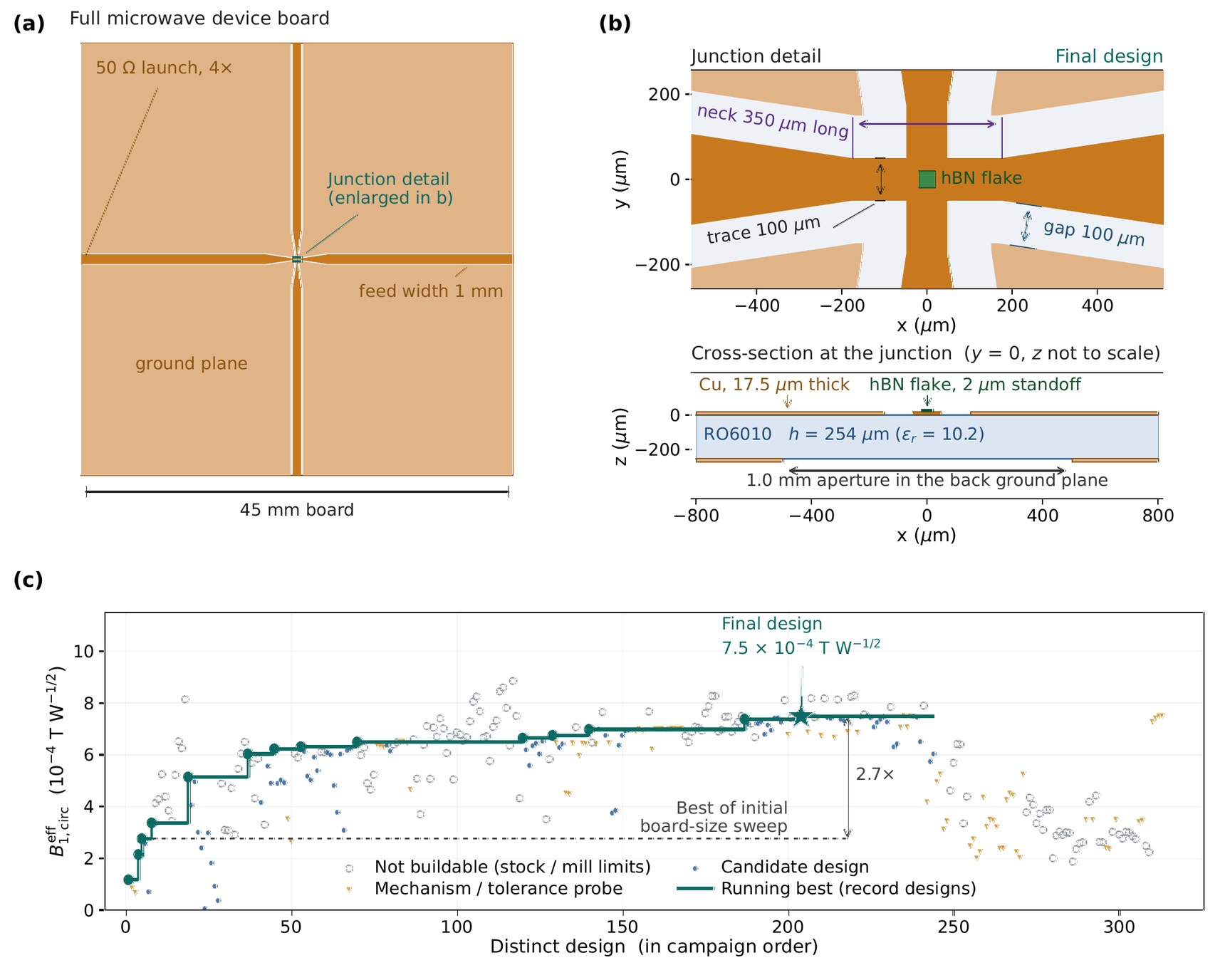
Researchers froze the score (simulated circular field at the sample per √W) and the lab's build limits, such as one 16 W amplifier. The collaborative agent proposed, ran and scored 418 simulations in six days; researchers twice corrected its physics.
Result
A symmetric 45 mm copper cross. In simulation: ≈119 MHz Rabi frequency at 16 W (4.2 ns π pulse), 2.7× the best of the agent's first size sweep. It reflects 81% of the power (counted in that figure); none of 4,896 matching networks reached spec.
Keep in mind
All results are simulations; fabrication and testing of the device are under way. The 2.7× compares with the agent's own first board-size sweep, not a published device.
In the preprint
Sec. IV.C, “Microwave device design,” and Fig. 4 of arXiv:2610.17193 describe the campaign and its checks in more detail.
- Data
- Simulation (Ansys HFSS finite-element solver)
- Models (as stated in the preprint)
- Claude Opus 5
- PhysKit version (as stated in the preprint)
- 0.6.0, an earlier version
- Where
- Sec. IV.C, Fig. 4
We list the versions the preprint reports so readers can trace each result to its tools, not as a recommendation: for new work, use the latest release.