
Case studies / Quantum-defect photophysics
Case study B · Model identification · measured data
Photodynamic model of a quantum defect
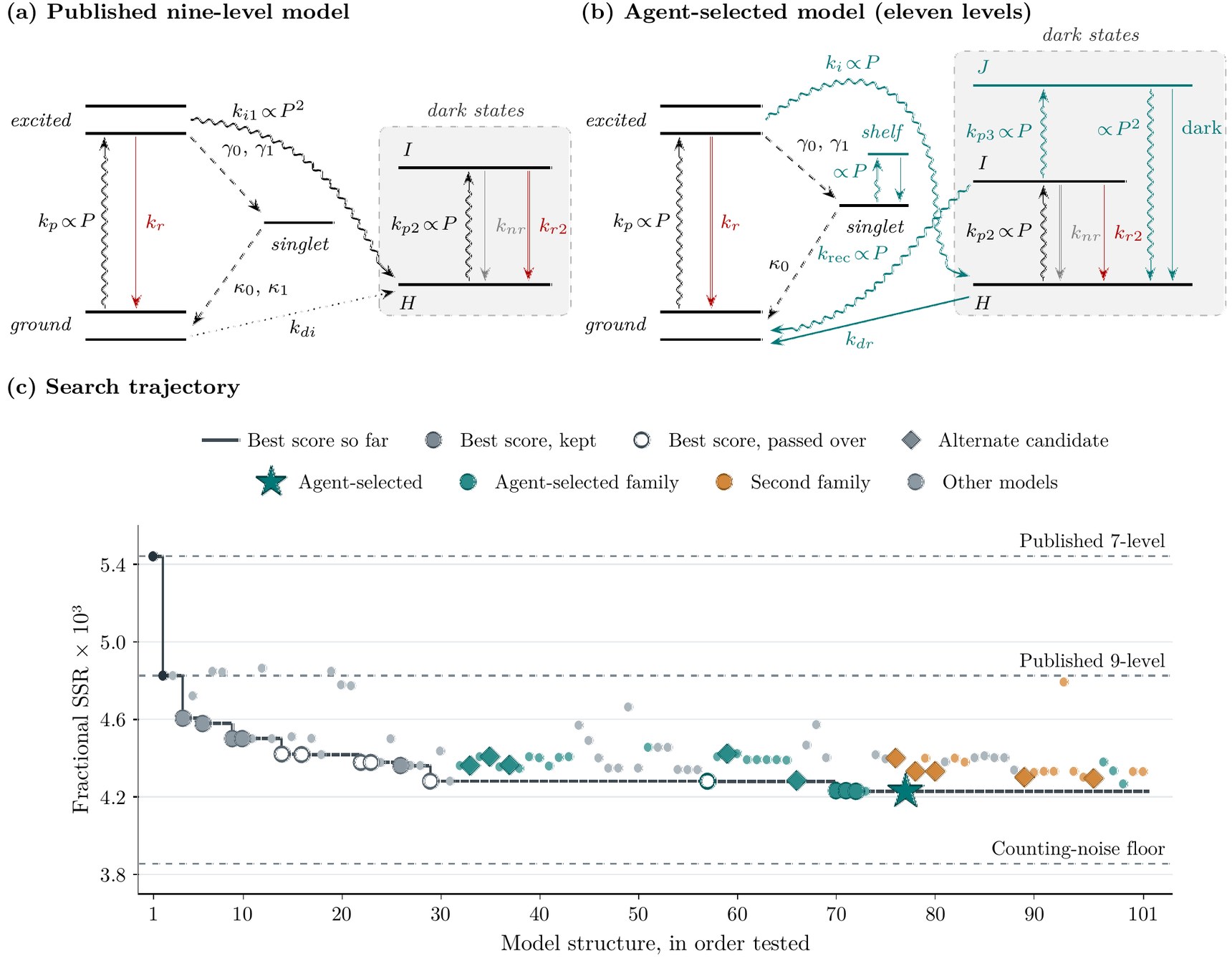
Testing 101 models of how a spin defect in hBN glows gave a better fit than both published ones.

The problem
The boron vacancy (VB−) in hexagonal boron nitride is a candidate 2D quantum sensor whose glow depends on its spin. Fitted rates disagree across studies; extra levels add free parameters, so a better fit alone isn't enough.
What we did
Starting from our published nine-level model, with scoring fixed in advance (one joint fit to measured photoluminescence at five laser powers), the collaborative agent fit 101 level schemes and tested promising ones on withheld powers. Researchers steered.
Result
An eleven-level model: one-photon entry into a ladder of three dark states, paths back to the ground state, and a light-driven shelf state. Fit error (SSR, smoothed traces) 0.83, vs 2.13 and 3.44 for the published nine- and seven-level models.
Keep in mind
Fit isn't proof: extra levels add free parameters, and the withheld-power comparison with the published seven-level model is being re-checked; two added states have no ab initio counterpart yet.
In the preprint
Sec. IV.B, “Improved photodynamic model for VB− spin defects in hBN,” and Fig. 3 of arXiv:2610.17193 describe the campaign and its checks in more detail.
- Data
- Measured data
- Models (as stated in the preprint)
- GPT 6 Astra
- PhysKit version (as stated in the preprint)
- 0.12.1, an earlier version
- Where
- Sec. IV.B, Fig. 3
We list the versions the preprint reports so readers can trace each result to its tools, not as a recommendation: for new work, use the latest release.