
Case studies / Current-density reconstruction
Case study A · Machine learning · synthetic test data
Current-density reconstruction
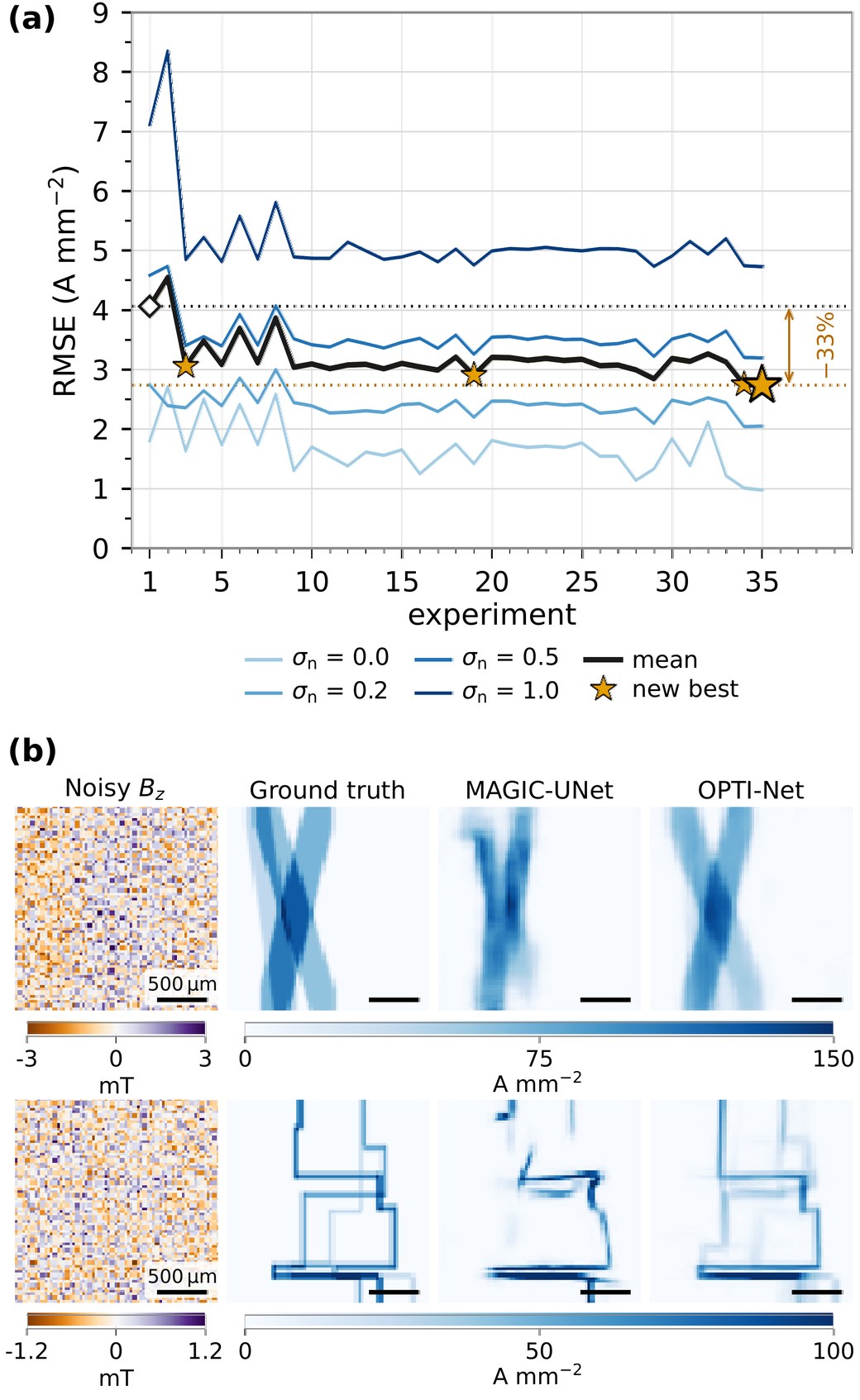
Mapping currents from noisy magnetic images with a third less test error than our published network.

The problem
Turning a magnetic image back into the currents that made it is an inverse problem: direct Biot–Savart inversion amplifies noise without bound. The bar to beat: MAGIC-UNet, our network for quantum diamond microscope images.
What we did
Researchers set the goal (lower average error on synthetic test images at four noise levels) and steered. The collaborative agent reproduced our published results, then searched networks and training, checking gains against seed-to-seed spread.
Result
OPTI-Net, a U-Net built to respect the pixel grid's 8 rotations and reflections and trained across noise levels: about 33% lower error on synthetic test data, ¼ the parameters. Physics-based add-ons didn't help.
Keep in mind
Scored on synthetic test data, averaged over four noise levels. Real microscope images have no ground truth, so no gain can be scored on them.
In the preprint
Sec. IV.A, “Current density reconstruction,” and Fig. 2 of arXiv:2610.17193 describe the campaign and its checks in more detail.
- Data
- Synthetic test data
- Models (as stated in the preprint)
- Claude Opus 4.8
- PhysKit version (as stated in the preprint)
- 0.6.0, an earlier version
- Where
- Sec. IV.A, Fig. 2
We list the versions the preprint reports so readers can trace each result to its tools, not as a recommendation: for new work, use the latest release.