
Case studies / NMR spectrometer commissioning
Case study E · Hardware control · live hardware
NMR spectrometer commissioning
A collaborative agent took an uncalibrated diamond-sensor NMR setup to a first scored run in 3.2 h.

The problem
NV-NMR detects NMR with nitrogen-vacancy centers in diamond instead of a pickup coil, so it can study sub-nanoliter samples. Setting one up (find resonances, calibrate pulses, tune acquisition) takes an expert's focused attention.
What we did
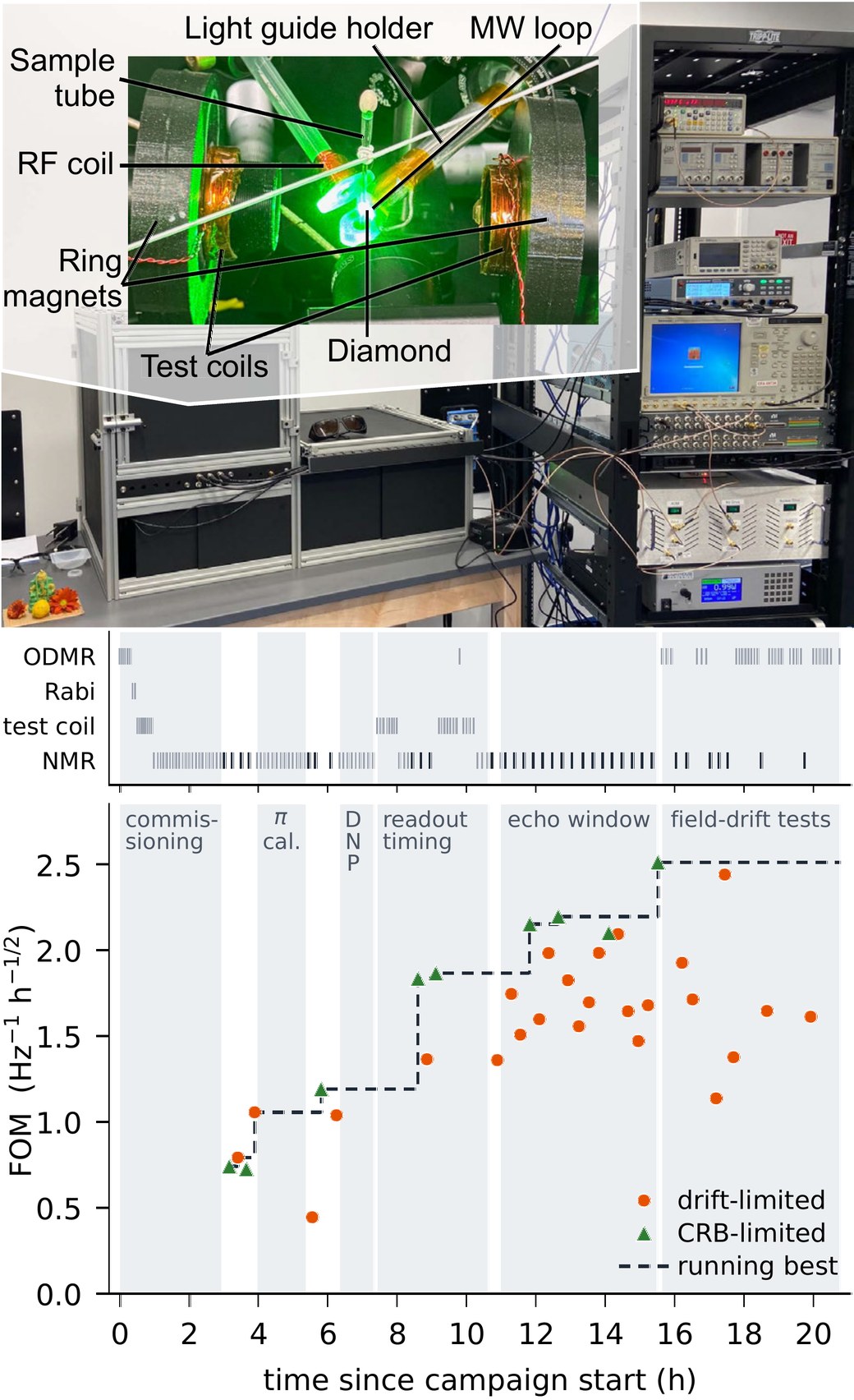
Researchers set the goal, a 36-h budget, safety limits, a figure of merit fixed in advance and an 8-step protocol with no parameter values. On live hardware the collaborative agent ran 151 experiments in 20.8 h, tuning one parameter at a time with controls.
Result
Proton NMR signal detected at 61 min; precision runs from 3.2 h. Best run: 0.97 Hz uncertainty (1.1 ppm) in 10 min; median of ten runs at the final settings 1.47 Hz. Best readout delay fell in the hand-found range.
Keep in mind
Drift, not the sensor, limited precision. An independent audit re-checked the scores yet rejected the agent's claim of a replicated record; the median is quoted too.
In the preprint
Sec. IV.E, “Nuclear magnetic resonance (NMR) experiment commissioning,” and Fig. 6 of arXiv:2610.17193 describe the campaign and its checks in more detail.
- Data
- Live hardware
- Models (as stated in the preprint)
- Claude Fable 5.1, Claude Opus 5.5, GPT 6 Astra (the preprint does not say which model did what)
- PhysKit version (as stated in the preprint)
- 0.12.1, an earlier version
- Where
- Sec. IV.E, Fig. 6
We list the versions the preprint reports so readers can trace each result to its tools, not as a recommendation: for new work, use the latest release.