
Case studies / Spin-ice microstate reconstruction
Case study F · Data analysis · measured data
Spin-ice microstate reconstruction
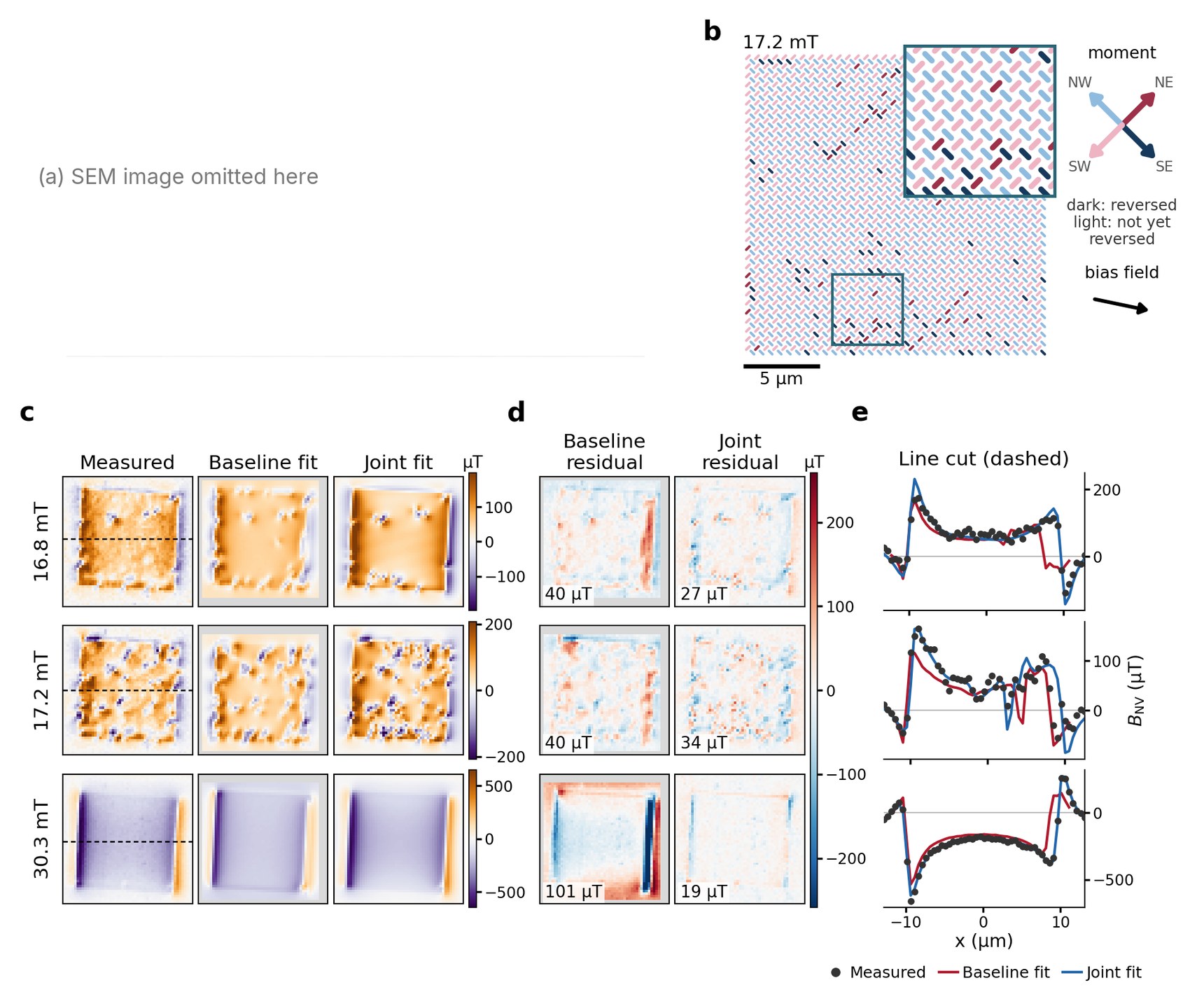
Reconstructing the states of 2,178 nanomagnets from magnetic images too blurry to resolve any one.

The problem
Artificial spin ice is a patterned array of nanomagnets, each a two-state Ising spin. A diamond (NV) imager ~700 nm away, with 500 nm pixels, suppresses single-island field detail ~10⁴–10⁵‑fold; about 12 parameters are uncertain.
What we did
Over ~2 months, researchers and collaborative agents ran about a dozen campaigns and sessions, building the physics model piece by piece. The final joint fit (each island flips at most once) was the team's earlier idea; agents later proposed it independently.
Result
To our knowledge, the first reconstruction of an artificial spin ice's Ising microstate from diffraction-limited magnetic imaging: each island's reversal across a 27-frame field sweep, now part of a forthcoming study.
Keep in mind
On current synthetic tests ~2.7% of island states come out wrong (5.6% in a noisier sweep; the preprint's 'under 2%' used an earlier benchmark); on real data, similarly good fits disagree on up to a third of islands mid-reversal.
In the preprint
Sec. IV.F, “Artificial spin-ice (ASI) magnetization reconstruction,” and Fig. 7 of arXiv:2610.17193 describe the campaign and its checks in more detail.
- Data
- Measured data (confocal NV magnetic images, 27-frame field sweep)
- Models (as stated in the preprint)
- Claude Sonnet 4.5, Sonnet 5, Opus 4.8, Opus 5, Fable 5 (several campaigns and sessions)
- PhysKit versions (as stated in the preprint)
- 0.3.0, 0.4.0, 0.6.0, earlier versions
- Where
- Sec. IV.F, Fig. 7
We list the versions the preprint reports so readers can trace each result to its tools, not as a recommendation: for new work, use the latest release.